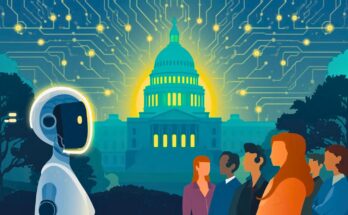
The field of generative artificial intelligence (GenAI) has advanced significantly from its experimental stage. By 2026, it will be more than just a tool for creating text, images, or videos but also a strategic co-pilot for various industries. GenAI is transforming workflows, decision-making, and creativity in industries as diverse as healthcare, education, finance, and entertainment. According to industry reports, more than 90% of businesses are investing in AI integration, with generative models leading the way.
This article investigates how GenAI is transforming data science, business, and society while also addressing issues of ethics, sustainability, and regulation.
What exactly is generative AI?
‘Generative AI’ refers to systems that can generate new content—text, images, audio, video, or even code—from training data. Unlike traditional AI, which primarily classifies or predicts, GenAI generates unique results that resemble human creativity.
The key capabilities include:
- Text creation (reports, essays, and translations)
- Image and video synthesis (art, design, and marketing).
- Code generation (software development and automation)
- Data augmentation (creating synthetic datasets for training)
GenAI for Data Science
By 2026, GenAI will have revolutionised data science. Instead of spending hours cleaning and preparing messy datasets, analysts now use AI to automatically preprocess and structure data. Plain-language queries enable non-technical professionals to gain insight without coding.
Impact Highlights:
- Accessibility: democratises data analysis for startups and small businesses.
- Efficiency: Reduces manual processing times by up to 70%.
- Decision-making: shifts attention away from technical barriers and towards actionable insights.
GenAI for Healthcare
Healthcare is one of the most promising areas for GenAI. Hospitals are now using AI to generate clinical documentation in real time, reducing doctors’ administrative workload.
The applications include:
- Ambient AI automatically records doctor-patient conversations as medical notes.
- Drug discovery: AI models can simulate molecular interactions more quickly than traditional labs.
- Personalised care: AI creates treatment plans based on patient history and genetic information.
GenAI for Business and Enterprise
Enterprises are incorporating GenAI into their workflows as a digital colleague. Examples are:
- Marketing: Automated campaign content generation.
- Customer service: AI-powered chatbots that exhibit human-like empathy.
- Finance: AI-based risk models and fraud detection.
- Education: Personalised learning modules with bilingual support (English and Urdu, for accessibility).
GenAI for creativity and media.
Generative AI is transforming art, music, and storytelling. By 2026, AI-assisted filmmaking and design will be mainstream. GenAI features are integrated into tools such as Canva and Cap Cut, allowing creators to quickly produce professional-grade content.
For educators like Uzay, this means that bilingual exam resources, AI-generated visuals, and user-friendly study materials can be produced on a large scale.
Challenges and risks
Despite its promise, GenAI raises critical concerns:
- Ethics: Who owns the content generated by AI?
- Bias: Models may reflect societal prejudices.
- Security: Synthetic data can be used to spread misinformation.
- Regulation: Governments are developing AI legislation to ensure transparency and accountability.
Sustainable GenAI
Training large AI models consumes a lot of energy. Companies plan to focus on green AI in 2026, with energy-efficient chips, optimised algorithms, and carbon-neutral data centres. Sustainability is no longer just a compliance requirement; it is also a competitive advantage.
Future Outlook
Experts predict that by 2030, GenAI will evolve into multiagent systems, which are AI agents that collaborate autonomously to solve complex problems. Quantum computing has the potential to accelerate this process, providing unprecedented creativity and problem-solving power.
In 2026, generative AI will no longer be a novelty but rather a strategic co-pilot shaping industries, creativity, and society. Its ability to democratise data, improve healthcare, and empower businesses makes it one of today’s most transformative technologies. Ethical, sustainable, and regulatory frameworks must evolve alongside it to ensure responsible growth.
For educators, entrepreneurs, and innovators, GenAI provides a powerful toolkit for creating accessible, inclusive, and future-ready resources.
- Generative AI Trends in 2026 | Top 10
- Generative AI: How it works and why it matters in 2026
- AI Year in Review: Trends shaping 2026
- AI Trends 2026: Quantum, Agentic AI & Smarter Automation
- Generative AI For Leaders Full Course (2026)
Articles & Websites
For deeper reading, these sites provide expert analysis and predictions:
- AI Adoption Trends in the Enterprise 2026 – TechRepublic
- CES 2026: AI compute shift from training to inference – Computerworld
- What’s Next for AI in 2026 – MIT Technology Review
- The Trends That Will Shape AI and Tech in 2026 – IBM
- Five Trends in AI and Data Science for 2026 – MIT Sloan Management Review