What if your phone could one day process information like a human brain using a fraction of the power? That future just got a lot closer. Engineers at Northwestern University have created printed artificial neurons that do something no lab-made neuron has reliably done before: they actually communicate with living brain cells. This is not science fiction. The research was published in Nature Nanotechnology on April 15, 2026, and the scientific world is taking notice.
What Did Scientists Actually Build?
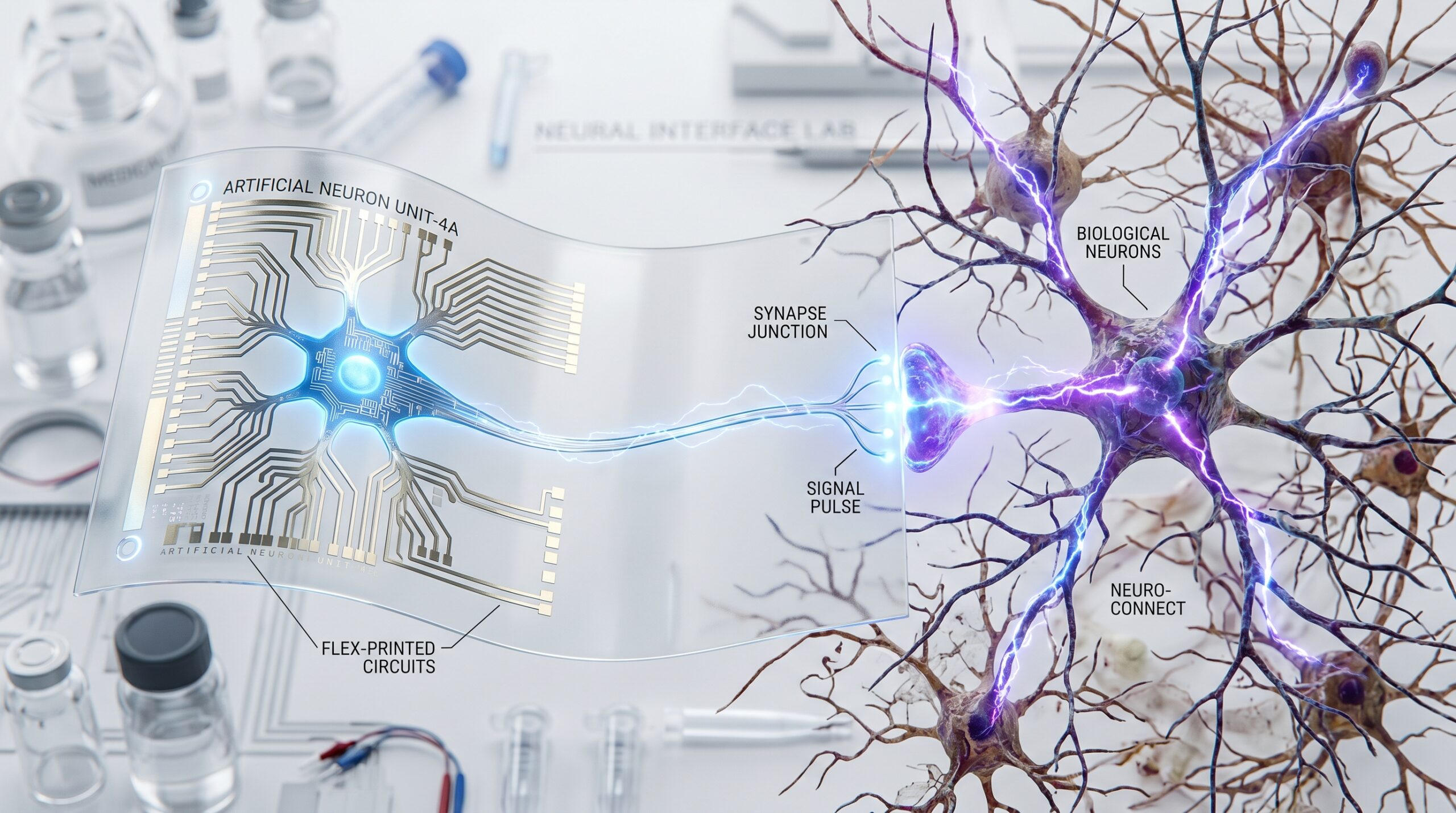
The Northwestern team, led by Professor Mark C. Hersam, developed flexible, low-cost devices using printable electronic inks. Instead of rigid silicon chips, these artificial neurons are printed onto a soft polymer using an aerosol jet printer—essentially a high-tech inkjet. The ink itself is formulated from nanoscale flakes of molybdenum disulfide (MoS₂), which acts as a semiconductor, combined with graphene as an electrical conductor.
The real magic happened during manufacturing.
By only partially burning off the stabilizing polymer in the ink instead of removing it entirely, the team introduced tiny imperfections into the structure. These imperfections create a conductive thread where electric current gets squeezed into a tight channel, causing rapid on-off firing that closely mirrors the behavior of real neurons. The result: artificial neurons that fire not just simple pulses but complex patterns, isolated spikes, sustained firing, and rhythmic bursts just like biological brain cells.
The Breakthrough: Talking to a Real Brain
To test whether these artificial signals were truly brain-compatible, the researchers partnered with Northwestern neurobiology professor Indira Raman. They connected the printed neurons to slices of actual mouse cerebellum tissue and fired signals directly into it.
The living neurons responded. The artificial signals were convincing enough in timing and shape to activate real neural circuits, a level of biological compatibility no previous artificial neuron had achieved. As Professor Hersam put it, the team demonstrated signals that are “in the right time range” and have “the right spike shape” to interact directly with living neurons.
This is a milestone that opens a genuine conversation between electronics and biology.
Why This Matters for AI’s Energy Crisis
The timing of this discovery is no coincidence. AI is consuming power at a frightening scale. Tech companies are building gigawatt data centers, some powered by dedicated nuclear plants. Cooling these centers requires massive amounts of water. As Hersam bluntly stated in the research announcement, it is hard to imagine a next-generation data center requiring 100 nuclear power plants.
The human brain offers a stunning contrast. It operates five orders of magnitude more energy efficiently than a digital computer. Today’s AI systems use billions of identical silicon transistors, all rigid, uniform, and power-hungry. The brain, by contrast, is heterogeneous, dynamic, and three-dimensional.
By creating artificial neurons that mimic this diversity and complexity — using just two printed devices instead of millions — the Northwestern team is laying the groundwork for neuromorphic computing: a new generation of hardware that processes AI workloads using brain-like efficiency. The manufacturing process is also additive, placing material only where needed, reducing waste and cost.
Real-World Applications: Medicine, Implants, and Beyond
The implications stretch well beyond data centers. Because these artificial neurons can directly interface with living tissue, they hold enormous promise for medical applications:
• Neuroprosthetics: Restoring lost functions such as hearing, vision, or movement by seamlessly connecting devices to the nervous system.
• Brain-Computer Interfaces (BCI): Enabling patients with paralysis or neurodegenerative diseases to control devices using thought alone.
• Alzheimer’s and Neurodegeneration: Scientists have suggested artificial neurons could potentially replace damaged nerve cells, offering a pathway to restore lost brain function.
• Bioelectronic Medicine: Treating conditions by precisely stimulating nervous system pathways without drugs.
How Does It Compare to Existing Technology?
Previous artificial neurons existed, but they fell short. Most produced simplified, uniform signals—lacking the rich, varied firing patterns of real brain cells. This forced neuromorphic chips to use millions of these neurons to achieve modest functionality, defeating the purpose of energy efficiency.
The Northwestern neurons achieve diverse, complex signaling from just a small number of devices. Their soft, flexible form also makes them far more compatible with brain tissue than rigid silicon alternatives, which creates problems when implanted in the soft, curved structures of the human brain.
Artificial neurons that genuinely talk to real brain cells represent a convergence of two of the most pressing challenges of our era: the energy crisis in AI computing and the medical need for better brain interfaces. Northwestern’s breakthrough, published in Nature Nanotechnology, is not a product yet — but it is a credible, peer-reviewed scientific foundation that future engineers will build upon.
The brain has been the most efficient computer in existence for millions of years. We are finally starting to learn how to speak its language.