Have you ever stopped to think about how big our universe really is? On Earth, we measure road trips in hours and cross-country flights in minutes saved. Even when we talk about space exploration, we usually celebrate calendar milestones—like a Mars rover surviving ten years on the red planet or astronauts spending twelve months aboard the International Space Station.
Today, November 18, 2026, NASA’s Voyager 1 spacecraft just crossed a finish line that has nothing to do with a calendar. It is strictly about distance. And frankly, it is so far away that our everyday brains struggle to picture it.
At exactly 10:16:07 UTC this morning, Voyager 1 slipped past an invisible cosmic marker roughly 16.094 billion miles (25.902 billion kilometers) from Earth. In astronomical terms, that means our little 1970s-era space probe just became the first human-made object in history to reach one light-day away from home. Think about that for a second. A beam of light—the fastest thing in the entire universe—now needs a full 24 hours just to travel from your backyard to Voyager 1.
What Does It Mean to Be One Light-Day Away?
When people hear the phrase “light-day” or “light-year,” it is easy to get tripped up by the word day or year. You might naturally assume it is a measurement of time. In reality, it is a ruler for distance.
Because outer space is so mind-bogglingly vast, standard miles and kilometers quickly turn into messy strings of zeros that nobody can read easily. Astronomers solved this problem by using the speed of light as a cosmic measuring tape. One light-day is simply the total distance a single photon of light travels through the vacuum of space in 24 hours.
The Universal Speed Limit Explained
To appreciate how far Voyager 1 has traveled, you have to respect the speed of light. Physics sets a strict speed limit on the cosmos, and nothing with mass can break it. Light—along with radio waves, X-rays, and all other forms of electromagnetic radiation—blasts through empty space at roughly 186,282 miles per second (about 300,000 kilometers per second).
At that blistering pace, a ray of light could circle Earth’s equator nearly seven and a half times in a single heartbeat. When you flip on a bedroom lamp, light crosses the room so fast your eyes treat it as instantaneous. Yet even at 186,000 miles every second, space is so empty and wide that light itself starts to feel like a slow-moving train once you leave our planetary neighborhood.
Why Distance Masquerades as Time in Deep Space
Here is where things get weird—and wonderful. Because light takes time to travel, looking deep into space is literally looking backward in time.
When you glance up at the Moon on a clear night, you are not seeing the Moon as it exists right this second. You are seeing it as it looked about 1.3 seconds ago, because that is how long reflected sunlight took to cross the 238,855-mile gap to your eyes. Look at the Sun (safely, of course), and you are seeing it 8 minutes and 20 seconds in the past.
With Voyager 1 hitting the one-light-day mark today, that time-delay effect hits a brand-new level. If you had a super-powered telescope capable of spotting Voyager 1 right now, the image hitting your eye would show where the spacecraft was yesterday. You would be watching yesterday’s news play out in real time.
Putting 16.1 Billion Miles Into Human Perspective
Saying “16.1 billion miles” sounds impressive, right? The trouble is, human beings did not evolve to visualize billions of miles. Our intuition works great for a five-mile jog or a 300-mile weekend drive, not interstellar voids. Let’s shrink that number down using some familiar benchmarks so you can actually feel the scale of what Voyager 1 just pulled off.
Earthly Travel Comparisons: Jets, Cars, and Bullets
Imagine hopping onto a commercial passenger jet cruising at a steady 550 miles per hour. If you pointed that plane toward Voyager 1 with an endless supply of fuel, your flight would take more than 3,340 years. A flight touching down next to Voyager 1 today would have taken off around 1315 B.C.—back when King Tutankhamun was still ruling ancient Egypt.
What if you drove instead? Picture an infinite interstate highway stretching straight into the cosmos. Set your cruise control at 65 miles per hour, skip every bathroom break, and keep your foot off the brakes. You would spend roughly 28,250 years behind the wheel. You would have pulled out of your driveway during the height of the last Ice Age, back when woolly mammoths still roamed North America.
Even a high-velocity sniper bullet leaving a rifle barrel at over 2,200 miles per hour would need more than 820 years to cover one light-day. If that bullet hit Voyager 1 this morning, someone would have pulled the trigger around the year 1205, right as Genghis Khan was uniting the Mongol Empire.
Solar System Benchmarks: The Moon, the Sun, and Pluto
Earthly machines clearly do not cut it, so let’s compare Voyager 1’s location against our own solar system neighbors:
• The Moon: Light takes 1.3 seconds to reach our lunar neighbor. Voyager 1 is more than 67,000 times farther away from Earth than the Moon.
• The Sun: Sunlight needs about 8.3 minutes to cross the 93 million miles between the Sun and Earth. One light-day is roughly 173 times that distance.
• Mars: Depending on where Earth and Mars sit in their orbits, a radio signal takes anywhere from 4 to 24 minutes to bridge the gap.
• Pluto: Out in the freezing twilight of the Kuiper Belt, Pluto orbits an average of 3.67 billion miles from the Sun. Sunlight takes about 5.5 hours to reach Pluto. Voyager 1 has pushed more than four times farther into the dark than Pluto.
Astronomical Units (AU) vs. Light-Days
Planetary scientists love using a unit called the Astronomical Unit, or AU. One AU equals the average distance between Earth and the Sun—about 93 million miles. Measuring in AU keeps solar system math tidy: Jupiter sits around 5.2 AU from the Sun, Saturn is roughly 9.5 AU out, and Neptune orbits at about 30 AU.
Where is Voyager 1 right now? It sits at roughly 173.14 AU from Earth. Think of Earth’s orbit around the Sun as a dinner plate. Voyager 1 has traveled more than 173 dinner plates away from home, leaving the entire planetary neighborhood far behind in its rearview mirror.
How Voyager 1 Made the 49-Year Journey
Voyager 1 did not teleport to the edge of deep space overnight. Reaching one light-day required 49 years, two months, and 11 days of non-stop coasting through the void. Even today, as Voyager 1 tears through space at roughly 38,000 miles per hour—covering close to a million miles every single day—it still needed nearly half a century to cover the ground that a beam of light crosses in 24 hours.
The 1977 Launch and Planetary Grand Tour
Wind the clock back to September 5, 1977. Jimmy Carter was in the White House, Star Wars had just hit movie theaters that summer, and engineers at NASA’s Jet Propulsion Laboratory (JPL) launched Voyager 1 from Cape Canaveral, Florida. (Fun trivia: Voyager 2 actually launched 16 days earlier on August 20, 1977, though Voyager 1 took a faster trajectory and overtook its twin within months.)
NASA built the twin probes to take advantage of a rare geometric alignment of the outer planets that happens only once every 175 years. This cosmic alignment allowed a spacecraft to swing past Jupiter, Saturn, Uranus, and Neptune like a pinball bouncing off bumpers. Voyager 1’s primary mission lasted just four years: fly past Jupiter in 1979 and Saturn in 1980, snapping close-up portraits of swirling storms, volcanic moons like Io, and hazy Titan.
Gravity Assists: Nature’s Cosmic Slingshot
How did a 1970s rocket fling a 1,600-pound probe fast enough to escape the Sun’s massive gravitational pull? Rocket fuel alone could never have done the job. Instead, mission planners relied on a clever orbital trick called a gravity assist.
Picture a skateboarder grabbing onto the back bumper of a speeding truck for a few seconds before letting go. As Voyager 1 whipped closely around massive Jupiter and Saturn, it stole a tiny fraction of each planet’s orbital momentum. Jupiter didn’t even notice the microscopic tug, while Voyager 1 got hurled outward like a stone launched from a slingshot. Those planetary gravity boosts gave Voyager 1 enough permanent speed to break free from our solar system forever.
Crossing the Heliopause Into Interstellar Space
After completing its portrait of Saturn and tilting upward out of the plane of the planets, Voyager 1 kept coasting into the unknown. Then, on August 25, 2012, history happened again.
Our Sun constantly blows a giant bubble of charged particles and magnetic fields outward in every direction. Scientists call this protective bubble the heliosphere. Everything inside it—all eight planets, Pluto, comets, and asteroids—lives inside the Sun’s immediate magnetic neighborhood. On that August day in 2012, Voyager 1 punched through the outer boundary of that bubble, known as the heliopause, and officially entered interstellar space—the true ocean between the stars.
Talking Across a 48-Hour Communications Lag
For the small, dedicated team of flight engineers at NASA’s Jet Propulsion Laboratory who still operate Voyager 1, crossing the one-light-day line today changes the daily rhythm of their work.
Every single command sent to Voyager 1 travels via radio waves at the speed of light. That means every conversation with the spacecraft now carries a mandatory 48-hour round-trip delay. Let’s trace what that looks like on a real workweek:
• Monday at 9:00 AM: Mission controllers beam a command up to Voyager 1 telling it to adjust a heater or check an instrument.
• Tuesday at 9:00 AM: After flying through empty space for 24 hours, the radio signal finally reaches the spacecraft. Voyager 1 executes the instruction and beams back a confirmation signal.
• Wednesday at 9:00 AM: That faint return whisper lands on Earth, 48 hours after the team first hit “send”.
You cannot steer a spacecraft in real time with a two-day lag. Voyager 1 has to rely on its own onboard 1970s computers to stay pointed at Earth while engineers plan every move days in advance.
How NASA’s Deep Space Network Hears a Whisper
Even more astonishing than the delay is the sheer faintness of Voyager 1’s voice. The spacecraft’s radio transmitter broadcasts at roughly 23 watts—about the same electrical power as a standard refrigerator light bulb.
By the time that 23-watt signal spreads out across 16.1 billion miles of space, the energy hitting Earth is minuscule—measured in fractions of a billionth of a billionth of a watt. To catch that cosmic whisper, NASA relies on the Deep Space Network (DSN), a global trio of massive 70-meter (230-foot) dish antennas located in California, Spain, and Australia. Because Earth rotates, these three stations hand off tracking duties every eight hours so humanity never loses earshot of its farthest explorer.
Troubleshooting Across the Void: The 2023–2024 Memory Glitch
Living with a two-day communications lag becomes an agonizing test of nerves whenever something breaks on a nearly 50-year-old machine. Engineers saw this firsthand between November 2023 and April 2024.
Suddenly, Voyager 1 stopped sending readable science and engineering data. Instead, its radio beam carried an endless stream of gibberish ones and zeros. Something inside the Flight Data Subsystem—one of the probe’s three onboard computers—had gone wrong, and engineers couldn’t simply walk over and reboot a router.
Through painstaking detective work, the JPL team traced the culprit to a single corrupted memory chip. Because they couldn’t fix the physical hardware 15 billion miles away, they had to rewrite the spacecraft’s software code, slice the damaged instructions into smaller chunks, and tuck them into unused corners of healthy memory. Every single diagnostic poke and code upload required waiting nearly two full days just to see if the patient responded. Five months later, in April 2024, Voyager 1 finally started speaking clear English again—one of the greatest long-distance tech-support saves in engineering history.
How Voyager 1 Survives in the Freezing Dark
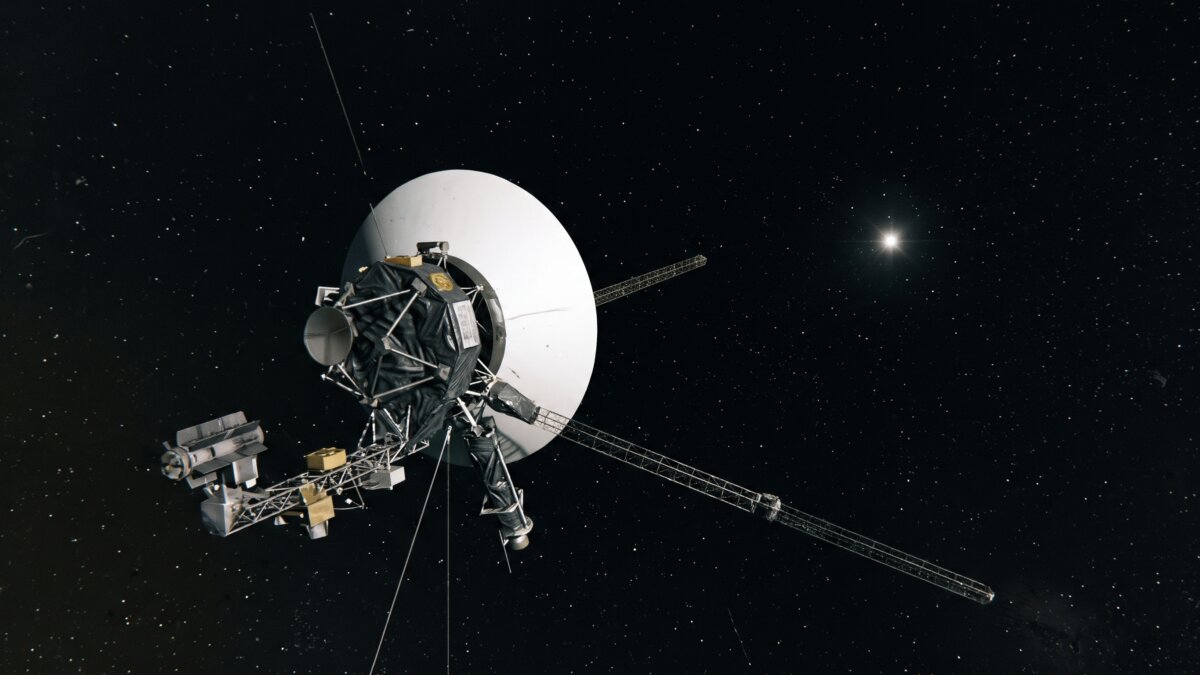
Out where Voyager 1 flies today, sunlight provides zero warmth and zero solar power. If you stood on Voyager 1’s dish antenna and looked back toward our solar system, the Sun would look like nothing more than an unusually bright pinpoint of light in a pitch-black sky.
How does a machine built with 1970s wire-wrap circuit boards and magnetic tape recorders survive temperatures hovering near minus 400 degrees Fahrenheit?
Decaying Plutonium and Shrinking Power Budgets
Because solar panels are useless far from the Sun, NASA equipped Voyager 1 with three Radioisotope Thermoelectric Generators (RTGs). These nuclear batteries contain spheres of plutonium-238. As the plutonium naturally decays, it produces steady heat, which thermocouples convert directly into electricity.
When Voyager 1 lifted off in 1977, those three RTGs generated about 470 watts of electrical power. Nearly five decades later, radioactive decay and aging components have cut that output nearly in half, and the spacecraft loses about 4 watts of power every single year.
To keep the core computer and radio transmitter warm enough to survive, flight controllers have acted like careful homeowners turning off lights in empty rooms. Over the years, NASA shut down Voyager 1’s cameras (right after snapping the famous “Pale Blue Dot” portrait in 1990), turned off non-essential heaters, and powered down several science instruments.
Which Science Instruments Are Still Running?
Even on a shoestring power budget, Voyager 1 refuses to quit working. Four primary science instruments remain switched on today, acting as humanity’s only direct weather station in interstellar space:
1. Cosmic Ray Subsystem (CRS): Measures high-energy particles zipping through the galaxy from distant supernova explosions.
2. Low-Energy Charged Particles (LECP): Tracks slower ions and electrons swirling around the boundary of our solar system.
3. Magnetometer (MAG): Maps the invisible interstellar magnetic field that threads between the stars.
4. Plasma Wave Subsystem (PWS): Listens to vibrations in the thin interstellar gas, helping scientists measure the density of space outside our Sun’s bubble.
What Comes Next for Voyager 1 and Voyager 2?
Reaching one light-day from Earth today is a huge party moment—complete with NASA’s global “Shine Bright” campaign inviting people to flash “V-G-R” in Morse code toward the night sky. Yet in cosmic terms, Voyager 1 has barely stepped off our front porch.
Reaching One Light-Day From the Sun in 2027
Here is a neat quirk of orbital mechanics: because Earth orbits the Sun at 67,000 miles per hour, our distance to Voyager 1 actually wobbles slightly throughout the year. Depending on which side of the Sun Earth is sitting on, we either rush toward Voyager 1 or pull away from it.
Right now, in November 2026, Earth’s orbital position puts us a full light-day away from the spacecraft. However, Voyager 1 still has a little farther to go before it sits one light-day away from the Sun itself. It will cross that solar one-light-day milestone in February 2027.
When Will Voyager 2 Catch Up?
What about Voyager 1’s twin brother? Voyager 2 took a slightly slower, scenic detour after Saturn so it could become the first—and still only—spacecraft to visit Uranus in 1986 and Neptune in 1989.
Because of that scenic route, Voyager 2 trails behind its sibling at roughly 13.3 billion miles from Earth (about 19.8 light-hours away). Voyager 2 is still healthy and sending back interstellar data of its own, and it is on track to hit the one-light-day mark from Earth in November 2035.
The 40,000-Year Drift Toward Another Star and the Golden Record
Eventually—likely sometime in the early-to-mid 2030s—Voyager 1’s plutonium batteries will drop too low to power even a single instrument or radio transmitter. When that day comes, Voyager 1 will go silent.
Going silent does not mean stopping, though. With zero air friction in space to slow it down, Voyager 1 will keep coasting outward at 38,000 miles per hour for millions—or even billions—of years. About 40,000 years from now, it will drift within 1.7 light-years of a small red dwarf star called Gliese 445 (also cataloged as AC+79 3888) in the constellation Camelopardalis.
Bolted to the side of the silent spacecraft is the famous Golden Record—a 12-inch gold-plated copper phonograph disc curated by astronomer Carl Sagan and his team. Inside that protective cover sit 115 analog images of life on Earth, recordings of surf, wind, thunder, whale songs, Bach, Chuck Berry’s “Johnny B. Goode,” and spoken greetings in 55 languages. Long after our cities and continents have reshaped themselves, Voyager 1 will carry a quiet time capsule of who we were across the Milky Way.
Conclusion: A Quiet Triumph of Human Curiosity
Voyager 1’s arrival at one light-day from Earth reminds us what happens when smart, stubborn people ask big questions and refuse to settle for easy answers. Built with less computing memory than a modern car key fob, this 49-year-old ambassador has outlived every expectation its creators ever dared to write down. Today, every photon of radio light traveling between Earth and Voyager 1 takes an entire rotation of our planet to make the trip—a silent, stretching bridge connecting a tiny blue world to the vast ocean between the stars.
Frequently Asked Questions (FAQs)
1. How far is one light-day in miles and kilometers?
One light-day is the exact distance light travels through empty space in 24 hours. It equals roughly 16.094 billion miles (or 25.902 billion kilometers), which works out to about 173 times the distance between Earth and the Sun.
2. When did Voyager 1 officially reach one light-day from Earth?
Voyager 1 crossed the one-light-day threshold from Earth on Wednesday, November 18, 2026, at 10:16:07 UTC (5:16:07 a.m. EST / 2:16:07 a.m. PST).
3. Is Voyager 1 outside our solar system?
Yes and no, depending on how you define the border. Voyager 1 exited the heliosphere—the Sun’s protective bubble of solar wind and magnetic fields—back in August 2012, entering interstellar space. However, it has not yet reached the Oort Cloud, a distant shell of icy comets loosely bound by the Sun’s gravity that extends nearly a light-year outward.
4. How long does it take to send a message to Voyager 1 and get a reply?
Because radio signals travel at the speed of light, it now takes 24 hours for a command from Earth to reach Voyager 1 and another 24 hours for the spacecraft’s reply to return. That creates a 48-hour (two-day) round-trip communication lag.
5. Will Voyager 1 ever reach another star system?
Voyager 1 is not aimed directly at any star, and space is extraordinarily empty. In roughly 40,000 years, it will make its closest approach to a star named Gliese 445 (AC+79 3888), passing within about 1.7 light-years of it before continuing its endless orbit around the center of the Milky Way galaxy.